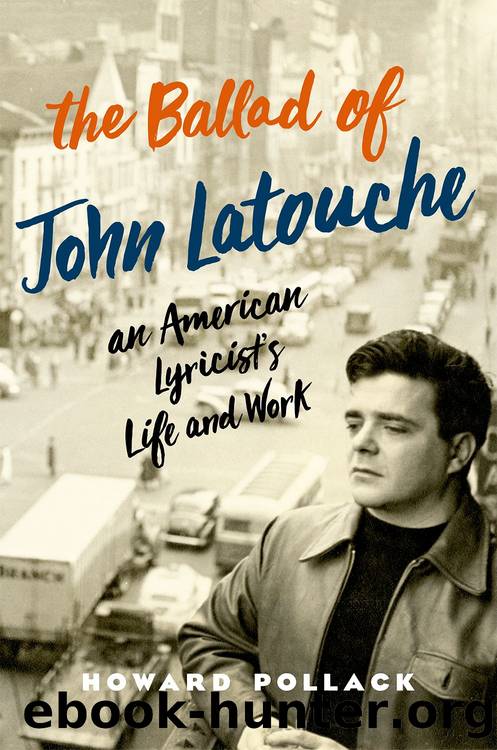
The Ballad of John Latouche by Howard Pollack
Author:Howard Pollack [Pollack, Howard]
Language: eng
Format: epub
ISBN: 9780190458317
Publisher: Oxford University Press
Published: 2017-09-05T00:00:00+00:00
Although Golden Ladder essentially dispensed with Latoucheâs lyrics, the show retained the daughters-in-law melodrama that he seems to have penned, while the overhauled words to âStore-bought Suitâ and âWe Got a Starâânow, âBranâ New Lookâ and âI See a Starââplainly showed traces of his work as well.
The similarly extended saga of The Happy Dollar proved more straightforward, at least in terms of authorship. The show seems to have originated with its bookwriter, Lee Falk (born Leon Gross, 1911â1999), best known as the creator and author of the successful newspaper comic strips Mandrake the Magician and The Phantom, but also active in the theater as author, producer, and director. In 1947, Falk wrote a musical comedy script, Hero Hill, which would become the basis of The Happy Dollar, and which piqued the interest of fledgling producer James Dunn (1901â1967), an accomplished actor who considered starring in the show himself.
For this reimagining of the Faust story as a western, Dunn hoped to reunite the team of composer Harold Arlen and lyricist E. Y. Harburg, sensing some connection between Falkâs play and Arlen and Harburgâs Bloomer Girl (1944)âand perhaps, too, with Finianâs Rainbow (1947), a recent hit by Harburg and Burton Lane. However, with Harburg unavailable, Dunn recruited by the end of 1947 an enthusiastic Latouche, whose Cabin in the Sky with Vernon Duke resembled this new vehicle even more closely. Indeed, when Latouche proposed to Duke that they collaborate on this show, the latter, although he liked Falkâs book, turned down the offer by explaining that they had âalready concocted a colored âCabin in the Skyâ ⦠Why bother with a white one?â In the end, as Duke further recalled, Latouche âhanded the bookâ to William Friml, âwho wrote a charming score to a great set of lyrics.â33
Still only in his twenties, pianist, arranger, and composer William Friml (1921â1973)âthe âgifted son,â as Duke wrote, of operetta composer Rudolf Friml and his third wife, actress Elsie Lawsonâhad studied music from an early age, giving piano recitals while still a boy. After some time at the University of Southern California, service in the army, and marriage to actress Shelby Payne, Friml established himself largely in Los Angeles as an arranger for a number of popular singers, although he maintained some involvement with the theater as well, including helping composer Burton Lane revamp the Broadway musical Flahooley as Jollyanna in 1952. According to his son, also named William, financial worries and chronic pain drove him to take his life at age fifty-one.34
Latouche and Friml collaborated on the score during the first half of 1948, and according to one source, completed the workâretitled The Happy Dollarâin June, with a production by Dunn in association with Don Medford, later a noted television director, and James Colligan, a theater manager, announced for the fall; but postponement followed postponement. In November, the press mentioned a possible leading role for operetta baritone Earl Wrightson; in December, a planned West Coast tryout with film stars Eddie Bracken and Vivian Blaine (the
Download
This site does not store any files on its server. We only index and link to content provided by other sites. Please contact the content providers to delete copyright contents if any and email us, we'll remove relevant links or contents immediately.
| Biographies | Business |
| History & Criticism | Instruments |
| Musical Genres | Recording & Sound |
| Reference | Songbooks |
| Theory, Composition & Performance |
The Goal (Off-Campus #4) by Elle Kennedy(13617)
Kathy Andrews Collection by Kathy Andrews(11769)
Diary of a Player by Brad Paisley(7523)
What Does This Button Do? by Bruce Dickinson(6174)
Assassin’s Fate by Robin Hobb(6169)
Big Little Lies by Liane Moriarty(5751)
Altered Sensations by David Pantalony(5076)
Pale Blue Dot by Carl Sagan(4966)
Sticky Fingers by Joe Hagan(4152)
The Death of the Heart by Elizabeth Bowen(3584)
The Heroin Diaries by Nikki Sixx(3522)
Beneath These Shadows by Meghan March(3283)
Confessions of a Video Vixen by Karrine Steffans(3278)
How Music Works by David Byrne(3238)
The Help by Kathryn Stockett(3118)
Jam by Jam (epub)(3056)
Harry Potter 4 - Harry Potter and The Goblet of Fire by J.K.Rowling(3037)
Computational Linguistics and Intelligent Text Processing: 20th International Conference, CICLing 2019 La Rochelle, France, April 7â13, 2019 Revised Selected Papers, Part I by Alexander Gelbukh(2968)
Strange Fascination: David Bowie: The Definitive Story by David Buckley(2839)
